Toxic Communication Patterns That Slowly Damage Relationships
Communication is at the heart of every relationship, but not all communication strengthens connection. Certain habits can gradually create emotional distance, resentment, and mistrust, particularly when they become the normal way partners respond to one another.
Often, these patterns develop slowly. A couple may still care deeply for each other while finding that conversations increasingly end in frustration, defensiveness, silence, or misunderstanding. For people searching for Couples Counselling near me, recognising these patterns can be an important first step towards changing them.
At Benoni Counselling Services, counselling psychologist Christopher Harper provides professional support for couples experiencing communication difficulties, recurring conflict, emotional disconnection, and other relationship challenges.
When Unhealthy Communication Becomes a Relationship Pattern
Every couple experiences disagreements. Having conflict does not automatically mean that a relationship is unhealthy or failing.
The concern is often not whether couples disagree, but how they communicate when they do.
A discussion about finances, parenting, intimacy, household responsibilities, family, or trust can quickly become something much bigger. Instead of addressing the original problem, partners may begin defending themselves, criticising each other, withdrawing, or bringing up previous hurts.
When this happens repeatedly, the communication pattern itself can become part of the problem.
Criticism That Becomes Personal
There is an important difference between raising a concern about someone’s behaviour and attacking their character.
For example, saying, “I felt overwhelmed when I had to handle everything alone,” communicates a specific experience. Saying, “You’re selfish and you never help me,” turns the conversation into a judgement about the other person.
Repeated personal criticism can leave a partner feeling inadequate, rejected, or constantly under attack. In response, they may become defensive or stop engaging openly altogether.
Over time, both partners can become more focused on protecting themselves than understanding each other.
Defensiveness and the Need to Prove Who Is Right
Defensiveness is a natural response when someone feels blamed. However, when it becomes the automatic response to difficult conversations, problems can become increasingly difficult to resolve.
A defensive conversation may include statements such as:
- “That’s not what happened.”
- “You do exactly the same thing.”
- “Everything is always my fault.”
- “You’re overreacting.”
- “Nothing I do is ever good enough.”
Instead of exploring what the other person is experiencing, both partners may become focused on proving their own position.
Eventually, arguments become less about finding a solution and more about deciding who is right and who is wrong.
Silence, Withdrawal and Shutting Down
Not every damaging communication pattern involves shouting or arguing.
Some people respond to conflict by becoming silent, emotionally withdrawing, leaving the conversation, or refusing to engage. In some situations, taking a short break can be healthy, particularly when emotions are becoming overwhelming.
However, there is a difference between saying, “I need some time to calm down, but I want to continue this conversation later,” and completely shutting a partner out.
When withdrawal becomes habitual, the other partner may feel abandoned, ignored, or emotionally rejected. They may then push harder for a response, causing the withdrawing partner to retreat even further.
This can create a frustrating cycle in which one person pursues connection while the other continually pulls away.
Sarcasm, Contempt and Disrespect
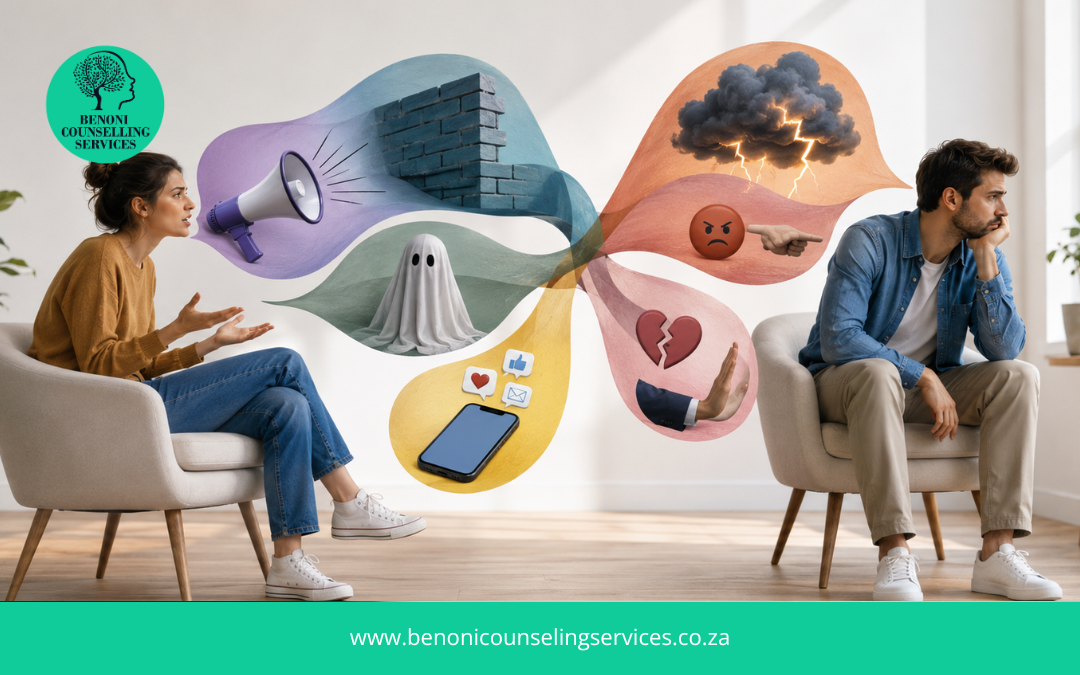
Sarcasm can sometimes appear harmless, particularly when humour is a normal part of a relationship. However, sarcasm that is repeatedly used to belittle, embarrass, or dismiss a partner can gradually undermine respect.
Contempt may appear through:
- Eye-rolling
- Mocking
- Name-calling
- Cruel jokes
- Dismissive facial expressions
- Belittling someone’s feelings
- Speaking to a partner as though they are inferior
These behaviours can make emotional vulnerability increasingly difficult.
If someone expects their feelings to be mocked or dismissed, they may eventually stop sharing them. The relationship can then become emotionally distant even if the couple continues functioning normally in other areas of life.
Bringing Old Hurt Into New Arguments
Sometimes an argument that appears to be about something small is actually connected to a much older wound.
A disagreement about being late, forgetting a responsibility, spending money, or not responding to a message may suddenly include previous betrayals, disappointments, family conflicts, or painful things said months or years earlier.
When old issues continually reappear, it may indicate that the underlying hurt has never been fully addressed.
One partner may feel frustrated because the past keeps being brought up. Meanwhile, the other may feel that their pain was never properly acknowledged in the first place.
Without resolution, couples can become trapped in arguments where the present problem and the past hurt become almost impossible to separate.
Keeping Score in the Relationship
Relationships can become emotionally exhausting when partners begin keeping a mental record of who has done more, sacrificed more, apologised more, or made more mistakes.
Arguments may begin to sound like:
“I always apologise first.”
“I do much more around here than you do.”
“You did exactly the same thing last month.”
“I’ve sacrificed more for this relationship.”
Accountability is important, but relationships rarely benefit from becoming competitions.
When every disagreement becomes an opportunity to compare contributions or past mistakes, couples may lose sight of what they actually need from each other.
Expecting Your Partner to Know What You Need
People sometimes assume that a loving partner should automatically know what they are thinking or feeling.
Thoughts such as “I shouldn’t have to ask” or “If they really cared, they would know” can feel understandable. However, even partners who have been together for many years cannot reliably read each other’s minds.
Unspoken expectations can eventually turn into disappointment and resentment.
Clear communication gives a partner the opportunity to understand what is needed rather than expecting them to guess correctly.
Avoiding Important Conversations
Some couples experience very little visible conflict because difficult topics are rarely discussed.
Concerns about intimacy, finances, parenting, boundaries, trust, extended family, responsibilities, or emotional needs may be avoided because both partners fear starting an argument.
Avoidance can create temporary peace. However, the underlying issue usually remains.
Over time, partners may begin living alongside each other rather than genuinely connecting. The absence of arguments does not necessarily mean that the underlying relationship difficulties have been resolved.
How Toxic Communication Patterns Reinforce Each Other
Communication problems rarely occur independently.
For example, one partner may criticise because they feel ignored. The other becomes defensive because they feel attacked. The first person becomes increasingly frustrated and pushes harder, while the second withdraws further.
Eventually, both partners may feel misunderstood.
The important question is not always, “Who started it?”
A more useful question can be, “What keeps happening between us?”
Understanding the cycle allows couples to look at the relationship dynamic rather than treating each disagreement as an isolated incident.
Signs Your Communication May Be Damaging Your Relationship
It may be worth paying closer attention to your communication if:
- Small disagreements regularly become intense arguments.
- You repeatedly argue about the same issues.
- One or both partners feel unheard.
- You avoid certain subjects because they always cause conflict.
- Sarcasm, criticism, or resentment has become common.
- One partner frequently shuts down.
- You feel anxious about expressing your needs.
- Affection or emotional intimacy has decreased.
- Arguments focus on blame rather than solutions.
- You feel increasingly lonely within the relationship.
Experiencing these difficulties does not automatically mean that a relationship cannot improve. However, persistent patterns can indicate that the couple’s current approach to communication is no longer helping them resolve problems effectively.
Couples Counselling near me: When Is It Time to Seek Support?
Couples often wait until their relationship is in serious distress before considering counselling. However, support can also be valuable before communication difficulties reach that point.
If you are searching for Couples Counselling near me, you may already recognise that conversations between you and your partner are no longer leading to understanding or meaningful resolution.
Counselling can provide a structured environment where both partners have an opportunity to explore what happens during conflict, how each person responds emotionally, and what may be maintaining the cycle.
The purpose is not simply to decide who is right.
Instead, therapy can help couples understand what is happening beneath recurring arguments and develop healthier ways of responding to one another.
How Couples Counselling Can Support Healthier Communication
At Benoni Counselling Services, Christopher Harper works with couples experiencing a range of relationship and communication difficulties.
Depending on the needs of the couple, counselling may help partners:
- Identify recurring communication cycles.
- Express needs and concerns more clearly.
- Listen without immediately preparing a defence.
- Manage intense emotions during disagreements.
- Explore unresolved resentment or hurt.
- Develop healthier boundaries.
- Communicate difficult feelings more safely.
- Rebuild emotional connection.
- Approach problems collaboratively.
- Better understand each other’s perspectives.
Couples counselling does not mean that partners must agree about everything.
Instead, the goal can be to create healthier ways of navigating disagreement without repeatedly damaging trust, respect, or emotional connection.
Rebuilding Emotional Safety Between Partners
Healthy communication requires more than learning what to say during an argument. Partners also need to feel safe enough to communicate honestly.
Emotional safety means being able to express disappointment, uncertainty, frustration, fear, or vulnerability without automatically expecting ridicule, rejection, punishment, or escalation.
When communication has been strained for a long time, rebuilding this safety may not happen immediately.
However, recognising harmful patterns and learning different ways of responding can gradually change how partners experience difficult conversations.
Couples Counselling in Benoni with Christopher Harper
When the same arguments happen repeatedly, couples can begin to feel as though they have tried everything. Yet attempting to solve the same problem through the same communication pattern often leads back to familiar frustration.
Christopher Harper is a highly qualified and experienced counselling psychologist based in Benoni, South Africa. Through Benoni Counselling Services, he provides professional psychological support to couples who want to better understand their relationship difficulties and develop healthier ways of communicating.
For those searching for Couples Counselling near me, professional counselling can provide a neutral and supportive environment in which recurring conflict, emotional withdrawal, resentment, communication difficulties, and relationship concerns can be explored constructively.
Take the First Step Towards Healthier Communication
Toxic communication patterns can become deeply established, particularly when couples have been caught in the same cycle for months or years. However, recognising the pattern creates an opportunity to begin responding differently.
You do not have to wait until communication has completely broken down before seeking professional support.
Contact Benoni Counselling Services to schedule an appointment with Christopher Harper and take the first step towards healthier communication, greater understanding, and a more connected relationship.